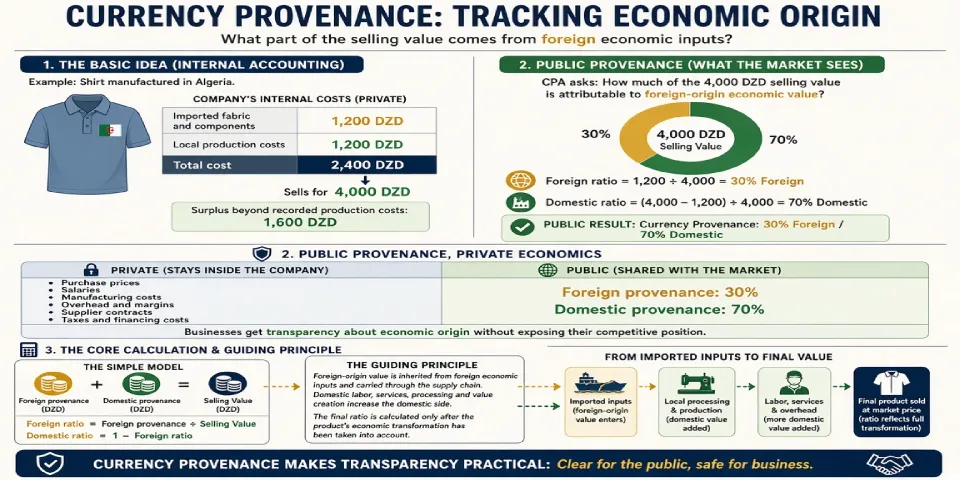
Currency Provenance Accounting: Measuring Where Economic Value Really Comes From
A simple idea for Algeria and the Global South: give every product a ratio that shows how much of its value is domestic and how much is foreign, without exposing a single cost or margin.
Reading time: about 10 minutes
Traditional accounting tells a company how much it buys, spends, sells and earns. But for Algeria and many other countries, another question matters more and more:
How much of a product's value comes from foreign economic inputs, and how much is created at home?
A product can be sold entirely in Algerian dinars and still depend heavily on foreign value. Another can contain imported inputs yet create a great deal of domestic value through manufacturing, labor, engineering and distribution.
Currency Provenance Accounting (CPA) adds a new dimension to accounting: every product or service carries a ratio showing the share of its selling value that has foreign provenance and the share that has domestic provenance. That ratio travels from company to company along the supply chain, and it never reveals costs, margins or confidential accounts.
1. The basic idea
Take a shirt manufactured in Algeria. Internally, the company's accounts look like this:
| Cost | Amount |
|---|---|
| Imported fabric and components | 1,200 DZD |
| Local production costs | 1,200 DZD |
| Total cost | 2,400 DZD |
The shirt sells for 4,000 DZD, leaving 1,600 DZD of surplus beyond recorded production costs.
The public provenance figure should not say "50% foreign / 50% domestic". That would only describe the cost structure. Instead, CPA asks:
How much of the 4,000 DZD selling value is attributable to foreign-origin economic value?
If the foreign-origin component is 1,200 DZD, then:
Foreign ratio = 1,200 ÷ 4,000 = 30%
Domestic ratio = (4,000 − 1,200) ÷ 4,000 = 70%
The public result is simply:
Currency Provenance: 30% Foreign / 70% Domestic
The company never has to reveal its 2,400 DZD internal cost. It publishes only the resulting ratio.
2. Public provenance, private economics
This is what makes the idea practical. It separates two kinds of information.
| Private (stays inside the company) | Public (shared with the market) |
|---|---|
|
Purchase prices Salaries Manufacturing costs Overhead and margins Supplier contracts Taxes and financing costs |
Foreign provenance: 30% Domestic provenance: 70% |
Businesses get transparency about economic origin without exposing their competitive position.
3. The core calculation
The simplest version of the model is:
Selling value = Foreign provenance + Domestic provenance
Foreign ratio = Foreign provenance ÷ Selling value
Domestic ratio = 1 − Foreign ratio
The hard part is determining the foreign-provenance amount correctly. The guiding principle is:
Foreign-origin value is inherited from foreign economic inputs and carried through the supply chain.
Domestic labor, services, processing and value creation increase the domestic side. The final ratio is calculated only after the product's economic transformation has been taken into account.
4. Following a shirt through the supply chain
Step 1: The manufacturer
Our Algerian clothing company imports fabric and accessories, then makes the shirt locally. Its full production costs:
| Component | Amount |
|---|---|
| Imported inputs | 1,200 DZD |
| Local labor | 600 DZD |
| Local electricity and services | 400 DZD |
| Other domestic costs | 200 DZD |
| Total cost | 2,400 DZD |
Selling price: 4,000 DZD. Foreign-origin value: 1,200 DZD. Domestic provenance: 4,000 − 1,200 = 2,800 DZD.
Published: 30% Foreign / 70% Domestic
The 1,200 DZD import cost, the 1,200 DZD local production cost and the 1,600 DZD surplus all stay private.
Step 2: The embroiderer
Another Algerian business buys the shirt for 4,000 DZD and embroiders it. It receives only the ratio, 30% / 70%, and can apply it to its purchase price:
4,000 × 30% = 1,200 DZD inherited foreign value
4,000 × 70% = 2,800 DZD inherited domestic value
Now the embroiderer adds its own inputs:
| New input | Amount | Provenance |
|---|---|---|
| Imported embroidery thread | 150 DZD | Foreign |
| Algerian labor | 400 DZD | Domestic |
| Electricity | 50 DZD | Domestic |
The totals after embroidery:
| Foreign | Domestic | |
|---|---|---|
| Inherited value | 1,200 | 2,800 |
| Added by embroiderer | 150 | 450 |
| Total | 1,350 DZD | 3,250 DZD |
The embroiderer sells the finished shirt for 5,000 DZD:
Foreign ratio = 1,350 ÷ 5,000 = 27%
Domestic ratio = 73%
Published: 27% Foreign / 73% Domestic
Notice what happened. The product became more domestic in economic terms, even though the embroiderer added another imported input. A larger amount of domestic activity was added relative to the final selling value. The ratio measures the composition of economic value, not merely the presence of imported materials.
Step 3: The rest of the chain
Manufacturer → Embroiderer → Distributor → Retailer → Consumer
At every stage, the company receives the previous ratio and adds its own contribution. The ratio is recalculated against the new transaction value. In this example, the distributor and retailer add domestic value only:
| Stage | Selling value | Foreign provenance |
|---|---|---|
| Shirt manufacturer | 4,000 DZD | 30% |
| Embroiderer | 5,000 DZD | 27% |
| Distributor | 5,500 DZD | 24.5% |
| Retailer | 6,000 DZD | 22.5% |
The percentages are never simply copied forward. They evolve as domestic value is added.
Provenance is inherited, transformed and recalculated.
5. The provenance passport
A future accounting system could attach a small digital record to each product or batch:
PRODUCT      Algerian Cotton Shirt
BATCH        SH-2026-00481

CURRENCY PROVENANCE
Foreign      30%
Domestic     70%

STANDARD     CPA-1
When another business transforms the product, it does not erase the original record. It creates a new provenance state, so the product builds up a provenance history:
Original shirt          30% Foreign / 70% Domestic
      ↓  embroidery added
Embroidered shirt       27% Foreign / 73% Domestic
      ↓  local packaging added
Packaged shirt          25% Foreign / 75% Domestic
6. Why this is not just "Made in Algeria"
A geographic label answers where a product was made. CPA answers a different question: what share of its economic value comes from domestic versus foreign origins?
A product assembled in Algeria can have very high foreign provenance. Another product built from imported raw materials can create far more domestic value. A label cannot tell them apart, but a ratio can.
Instead of the absolute claim "Made in Algeria", a company could say:
Made in Algeria — 72% Domestic Currency Provenance
That is a much richer statement.
7. A new commercial signal
Provenance does not have to stay an accounting concept. It can become a marketing tool, and a way to compare products.
Where it could appear
- On a website: "72% Domestic Economic Provenance"
- On packaging: a simple badge reading Domestic provenance 72%
- On an invoice: a line showing Domestic 72% / Foreign 28%
- In B2B sales: "Our machine contains 64% domestic economic provenance, compared with 35% for the previous imported solution."
The company is no longer marketing only the product. It is marketing the economic value it creates locally.
A new way to compare
Imagine two machines with the same price:
| Machine A | Machine B | |
|---|---|---|
| Price | 10,000,000 DZD | 10,000,000 DZD |
| Foreign provenance | 82% | 45% |
| Domestic provenance | 18% | 55% |
Price alone cannot show this difference. For a buyer concerned about import dependence, local maintenance or domestic industrial capability, it can change the decision. The same logic applies to furniture, clothing, electronics, industrial equipment, construction materials, software, professional services, food processing and packaging.
A new competitive language
Companies could compete on more than "cheaper, faster, better". They could also say:
- "Our production increased domestic provenance from 42% to 67% in three years."
- "85% of the economic value of our service is generated domestically."
For businesses building their identity around Algerian production, this is a meaningful new way to stand out.
Simple on the surface, detailed underneath
The public layer can stay at two numbers. A more advanced version could offer an authorized breakdown for those who need it:
| Foreign provenance | Domestic provenance |
|---|---|
|
Imported materials Foreign software Foreign equipment contribution Foreign services |
Labor Local materials Local services Engineering Domestic surplus |
8. From companies to an economy
For an Algerian business, CPA offers a language for something conventional accounting makes hard to see: how much economic value is actually created inside the country.
A company that imports a finished product and resells it generates revenue, jobs and a commercial margin. A company that imports raw materials and transforms them in Algeria may generate considerably more domestic value. Both are legitimate businesses, but their economic structures differ. CPA makes that difference measurable.
Now imagine thousands of companies using the same standard. Aggregated carefully, the ratios could paint a new picture of the economy, sector by sector:
| Sector | Foreign | Domestic |
|---|---|---|
| Textiles | 38% | 62% |
| Furniture | 25% | 75% |
| Electronics | 71% | 29% |
| Food processing | 22% | 78% |
| Industrial equipment | 64% | 36% |
| Software | 18% | 82% |
Illustrative figures only.
A country could then ask not only "How much do we produce?" but also:
How much of the value we produce originates domestically?
9. The principle in one equation
Selling value = Foreign provenance + Domestic provenance
Foreign ratio = Foreign provenance ÷ Selling value
Domestic ratio = 1 − Foreign ratio
The underlying accounting remains private. The resulting ratio can be shared, inherited by another business, transformed by its own activity and published again.
A middle ground for transparency
There are two extremes. On one side, no information about economic origin. On the other, full disclosure of costs and suppliers. CPA proposes a third path:
Public provenance, private economics.
A company can tell the market "this product represents 73% domestic economic provenance" without ever saying "our supplier charged us 2,140 DZD". That is what makes the concept commercially realistic.